NFC business card companies UK buyers can actually order from in 2026 are not all equal. This guide ranks and compares the top 20 NFC card companies UK professionals, agencies and enterprise teams shortlist most often – on hardware quality, platform features, pricing model, UK pricing and fulfilment, GDPR posture and support.
We looked at more than 40 NFC business card companies UK teams have bought from over the last two years and cut the list to 20. For each one, you get an honest read: who it suits, where it is weak, and how it stacks up against Evrycard.
Last updated: August 2026. Written by the team at Evrycard, a UK-based NFC and digital business card company. We build in this market every day, so we have been upfront about where we sit in this list and why. Every provider below is described from publicly available information at the time of writing.
Contents
- The short version
- How we ranked the NFC business card companies UK buyers shortlist
- NFC business card companies UK comparison table
- The top 20 NFC business card companies UK buyers should know
- Why NFC business card companies UK-side face a different market
- How to choose between NFC business card companies UK-wide
- Hardware: what the chip inside actually matters for
- How NFC business card companies UK price
- UK GDPR, PECR and data residency
- Rolling out to a team without chaos
- Ten mistakes buyers make with NFC business card companies UK
- How to switch provider
- Frequently asked questions
The short version
There are now well over a hundred businesses selling NFC business cards to UK buyers, and the market has quietly split into four very different types of company:
- Full-stack platforms – they make the card and the profile software, and they run both.
- Software-first apps – the digital profile is the product; the physical card is an accessory.
- Print and manufacturing specialists – excellent cards, minimal software.
- Tag and component suppliers – blank NTAG inlays and stickers for people who want to build their own.
Most bad purchases in this category happen because a buyer picks a company from one bucket while actually needing another. A marketing team that needs 60 cards with centrally managed profiles should not be buying blank NTAG215 inlays. A hobbyist who wants to programme five stickers does not need an enterprise seat licence.
This guide sorts the twenty most relevant companies for UK buyers into those buckets, explains what each is genuinely good at, and gives you a decision framework at the end. There are no affiliate links in this article and nobody paid to be included.
One clarification before we start, because it affects how you read our own entry: Evrycard runs two separate platforms. Evrycard UK (app.evrycard.co.uk) is the original UK product sold from evrycard.co.uk. Evrycard Global (app.evrycard.com) is a different, fuller platform with its own accounts, CRM integrations, native apps and extras such as Evrydrop, an AI card scanner, Eva AI, Experiences and Booking. On Global, buying an NFC card means no monthly or yearly fee at all; the monthly and yearly plans exist only for people who want the software without a card. Both platforms let you connect your own domain or subdomain with automatic SSL.
How we ranked the NFC business card companies UK buyers shortlist
We assessed every company against seven criteria that actually matter once a card is in your pocket:
- Hardware quality – chip generation (NTAG213 / 215 / 216), material (PVC, metal, bamboo, recycled), read reliability through phone cases, and print finish.
- Profile software – is there a real hosted profile, can you edit it after purchase, does it work without an app on the recipient’s phone?
- Team and admin features – bulk provisioning, central templates, employee onboarding and offboarding, role permissions.
- Pricing model – one-off purchase versus per-user subscription, and what happens to your card if you stop paying.
- UK fit – UK entity or UK fulfilment, GBP pricing, UK delivery times, clear itemised invoicing, UK or EU data residency.
- Compliance – UK GDPR posture, lawful basis for contact capture, data export and deletion.
- Support – response times, replacement policy, and whether a human answers when 40 cards arrive misprinted the week of a trade show.
We deliberately did not rank on marketing spend or social following. A company can be everywhere on Instagram and still ship a card with a read-once static URL burned into it.
NFC business card companies UK comparison table
| # | Company | Type | Best for | Pricing model |
|---|---|---|---|---|
| 1 | Evrycard | Full-stack (UK) | UK teams wanting cards + managed profiles with no per-user subscription | One-off with a card – no monthly fee (software-only plans optional) |
| 2 | V1CE | Full-stack | Premium metal cards and strong brand presence | One-off + paid tiers |
| 3 | Adapt ID | Full-stack (UK) | UK buyers wanting a straightforward shop experience | One-off |
| 4 | Tapt | Full-stack | Design-led cards with a clean profile editor | One-off + team plans |
| 5 | Blinq | Software-first | Large distributed sales teams already in a CRM | Per-user subscription |
| 6 | HiHello | Software-first | Contact management and card scanning at scale | Freemium + per-user |
| 7 | Popl | Full-stack | Event lead capture with a large accessory range | One-off + per-user |
| 8 | Wave | Full-stack | Consumer-friendly card range | One-off + plans |
| 9 | Mobilo | Full-stack | Enterprise IT integration and SSO | Per-user subscription |
| 10 | Linq | Full-stack | US-centric teams with event tooling | One-off + per-user |
| 11 | Dot | Full-stack | Slick mobile-first profiles | One-off + plans |
| 12 | Tapitag | Full-stack | Small businesses in the UK and Ireland | One-off |
| 13 | Tapilink | Full-stack (UK) | Budget-conscious UK buyers | One-off |
| 14 | Tapni | Full-stack | Wearables and non-card form factors | One-off + plans |
| 15 | Kinect Card | Full-stack (UK) | Simple single-user cards | One-off |
| 16 | Doorway | Software-first | Profile-led personal branding | Freemium |
| 17 | FDS Cards | Print specialist (UK) | Bespoke print finishes and unusual materials | Per-order quote |
| 18 | ZipNFC | Tag supplier (UK) | Bulk blank tags and inlays | Per-unit, volume tiers |
| 19 | NFC Tagify | Tag supplier (UK) | Custom-encoded tags and stickers | Per-unit |
| 20 | Eccel Technology | Component supplier (UK) | Readers, modules and integration hardware | Per-unit / B2B |
Types and “best for” labels reflect our reading of each company’s public positioning in 2026. Pricing models change often – always check directly before ordering.
The top 20 NFC business card companies UK buyers should know
1. Evrycard – best overall for UK teams
Type: Full-stack UK platform | Cards from: one-off purchase | Subscription required: no
We will declare the obvious conflict of interest: this is our company. So rather than tell you we are the best at everything, here is precisely the buyer we built Evrycard for, and the buyer we did not.
Evrycard is a UK-based NFC and digital business card platform. We make the physical cards and we run the profile software behind them, which means one company is accountable when something goes wrong. Cards use NTAG216-class chips, are encoded to a stable profile URL, and are re-pointable from your dashboard – you change the destination, not the card.
What we do well
- No per-user subscription for the core product. You buy the card once. Your profile stays live. This is the single biggest structural difference between us and most software-first platforms, where cards stop working the month a card payment fails.
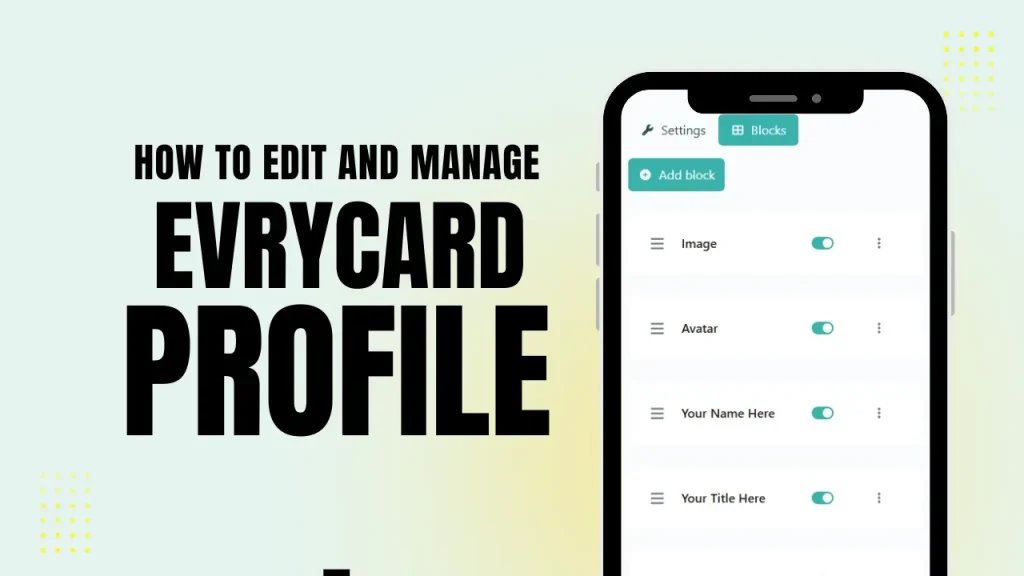
- Team management a non-technical office manager can run. Bulk order, apply a brand template across every profile, onboard a new starter in under a minute, and revoke a leaver’s card instantly.
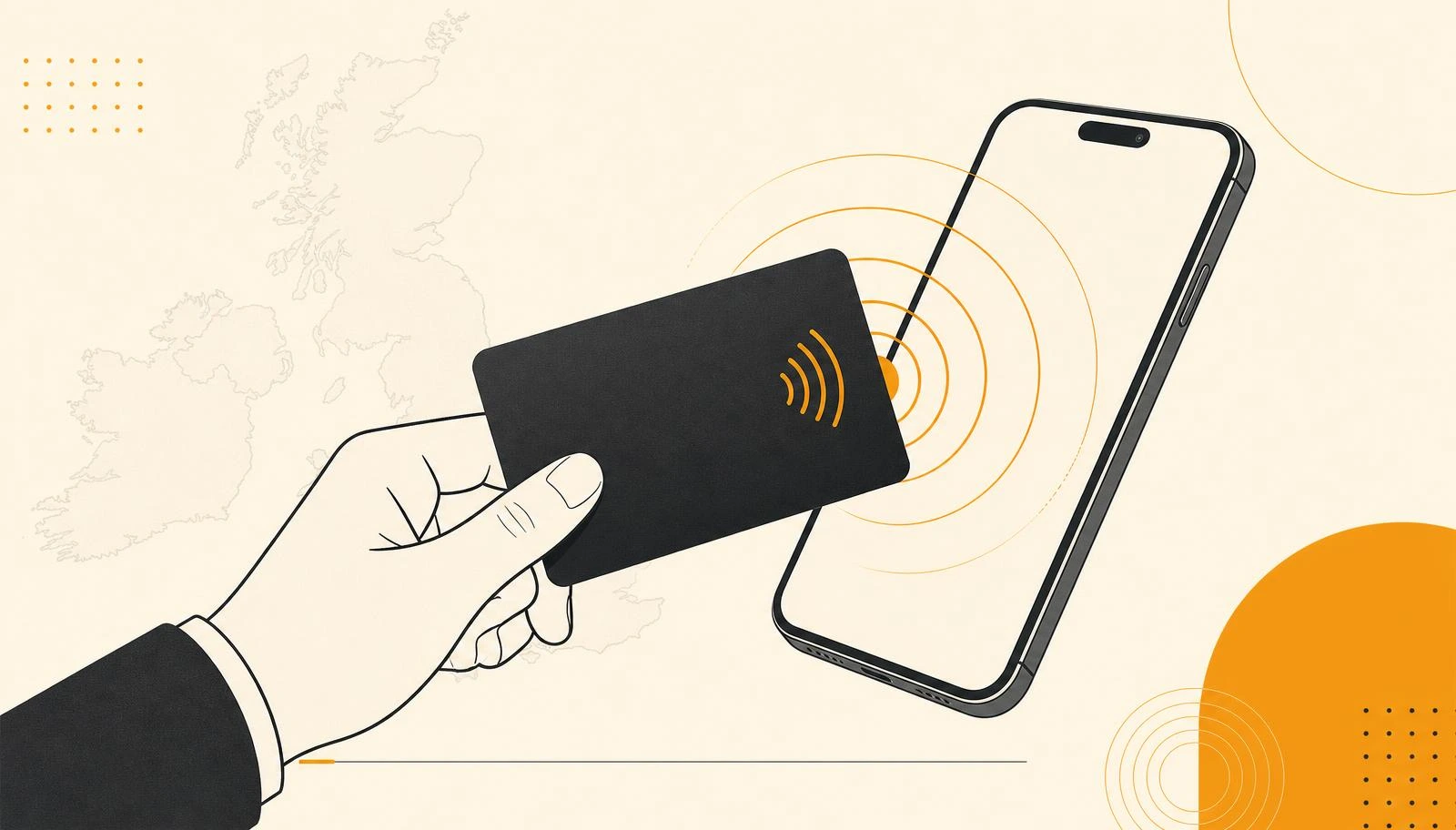
- No app needed on either side. The recipient taps, a web profile opens, they save the contact. No download, no account, no friction – which matters enormously at a trade stand.
- UK-first operations. GBP pricing with itemised invoices, UK fulfilment and tracked delivery, UK business-hours support, and a UK GDPR posture built for British buyers rather than retrofitted from a US privacy policy.
- Live analytics. Taps, profile views, link clicks and contact saves, per card and per team member – so procurement can see what the spend bought.
Two platforms: Evrycard UK and Evrycard Global
Evrycard runs two separate platforms, and it is worth being clear about which one you are signing into. Evrycard UK (app.evrycard.co.uk) is the original UK product, bought and managed from evrycard.co.uk. Evrycard Global (app.evrycard.com) is the newer, fuller platform – a different system with its own accounts, not a rebadged version of the UK app. If you want the deepest feature set, CRM integrations and native apps, that is Global.
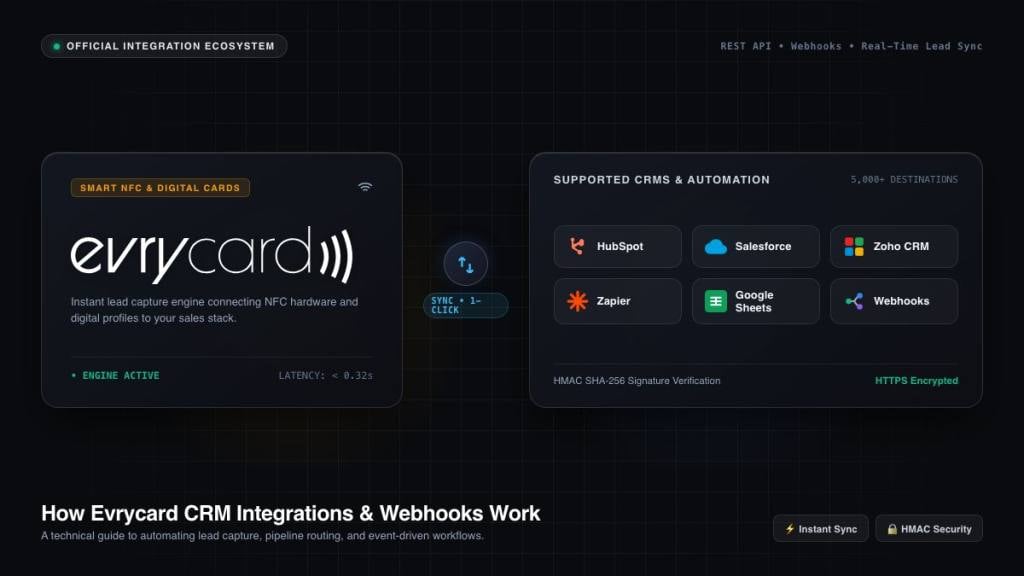
- CRM integrations as standard, not a bolt-on. One-click sync and webhook delivery into Salesforce, HubSpot, Zoho CRM, Pipedrive and Microsoft Dynamics, plus Zapier for 5,000+ other apps, Google Calendar, Outlook, Mailchimp and Slack. If your CRM is not on that list you can embed your own CRM or marketing form directly inside a profile, so leads land natively in whatever system you already run.
- A built-in CRM if you do not have one. Captured leads land in a Kanban pipeline with automated day 0, day 2 and day 5 follow-up prompts – useful for smaller teams who do not want to buy Salesforce to chase twelve conference leads.
- Native iOS and Android apps. Face ID and biometric login, push notifications, offline lead capture and full NFC support on both platforms, with an APK available for managed Android fleets.
- Team and enterprise controls. Teams and managers, role-based permissions, bulk profile import, bulk NFC ordering with volume pricing, brand-kit locking, admin-assigned card activations, custom domains with automatic SSL, team analytics and 2FA on every account.
- Buy a card, pay nothing monthly. On Evrycard Global, purchasing an NFC card means there is no monthly or yearly fee at all – the card and its profile are yours outright. If you would rather not buy a card, Global also sells the software on its own with monthly or yearly plans (Pro at £4.99 per month, Enterprise at £29.99 per month for unlimited profiles, after a 15-day free trial). Two routes, and only the card-free route carries a recurring bill.
- More than a profile. Global also ships Evrydrop for instant app-to-app sharing between Evrycard users, an AI business-card scanner that turns paper cards into contacts, Eva AI as an assistant on top of your profile and leads, Experiences for events and campaigns, and built-in Booking so people can put time in your calendar straight from your card.
- Your own domain. Connect a custom domain or subdomain to your account with automatic SSL – available on both Evrycard UK and Evrycard Global.
- Your own live chat, free for Enterprise. Enterprise customers on Evrycard Global get the live chat product included as a gift: build your own chat widget, paste the snippet into your website, and talk to your customers from the dashboard. Add as many agents as you need, and customise everything – colours, avatar, greeting, position, office hours and routing – so it looks like part of your own brand rather than a third-party bolt-on.
- Genuinely international. Prices are held in GBP but the storefront auto-detects and displays over twenty currencies, and we ship worldwide – 1 to 3 working days in the UK, 5 to 10 days internationally – with GBP checkout and itemised invoices for British buyers.
The practical upshot for this comparison: where older reviews described Evrycard as strong on hardware and light on integrations, that gap has closed on the Global platform. See the full platform at evrycard.com.
Where we are not the right fit
- If you need a fully white-labelled platform to resell under your own brand, we are not set up as a reseller platform. (Branding on your own domain is covered, though – both Evrycard UK and Evrycard Global let you connect your own domain or subdomain to your account, with automatic SSL.)
- If you want one bespoke hand-finished card in brushed titanium with a hand-engraved crest, a specialist print house will beat us on exotic materials.
- If you only need fifty blank stickers to programme yourself, buy inlays from a tag supplier – do not pay for a platform you will not log into.
For the large middle of the UK market – a business of one to five hundred people that wants smart cards that look good, work every time, and carry no recurring per-head bill – we think we are the strongest option on this list, and we built the company on that specific bet.
Browse our full range of Evrycard NFC business cards, or read our in-depth UK buying guide to explore finishes and hardware options.
2. V1CE – premium metal cards and mainstream brand awareness
Type: Full-stack | Best for: buyers who want a heavyweight premium card
V1CE is one of the most visible names in the category and has done more than most to make NFC business cards a mainstream purchase in Britain. The range leans into premium finishes – metal, black-on-black, bamboo – and the cards feel substantial in the hand, which is genuinely part of the pitch when you are handing one to a prospective client.
The platform side has matured considerably, with a profile builder, analytics and team functionality. Buyers should check which capabilities sit behind paid tiers before committing a whole department, and confirm what happens to profiles if a plan lapses. If your priority is the physical object making an impression, V1CE consistently delivers on that.
Commercially, V1CE is a direct-to-consumer brand first and a platform second, and that shows in how the range is merchandised: finish and material are the headline, software is the supporting act. For a founder, an estate agent or a consultant who wants the card itself to do social work in the room, that is a rational purchase. For a 60-person sales organisation, the questions change – who owns the profiles, what happens at renewal, and how quickly can IT revoke a leaver.
Procurement tip: ask for written confirmation of which analytics, CRM export and team-template features sit on which tier, and what the renewal price is at your seat count in year two. Premium hardware plus per-seat software is a perfectly reasonable model, but you want the three-year number before you standardise on it.
Strengths
- Genuinely premium materials – metal, bamboo and black-on-black cards that feel deliberate when handed over
- High brand recognition in the UK, so buyers rarely have to explain what the card is
- Mature profile builder with analytics and team functionality on the higher tiers
Watch-outs
- Several platform capabilities sit behind paid tiers, so the sticker price is not the whole cost
- Confirm what happens to live profiles if a plan lapses before rolling out at scale
- Metal cards can be harder to reprint quickly when a job title changes
Compared with Evrycard
Both ship a proper physical product, but the commercial models differ. V1CE leans on premium finishes with platform features tiered across paid plans; Evrycard sells the card once in GBP with profile editing, team controls and analytics included, so a card you handed out two years ago still resolves without an active subscription.
- Pricing model: V1CE combines a one-off card purchase with tiered plans; Evrycard sells the card once in GBP and includes profile editing, team controls and analytics without a per-user plan.
- Continuity: with Evrycard, a card handed out two years ago still resolves even if you never log in again – there is no plan to lapse.
- Team admin: bulk provisioning, locked brand templates and leaver revocation are standard on Evrycard rather than an upgrade.
- Platform depth: Evrycard Global adds CRM sync to Salesforce, HubSpot, Zoho, Pipedrive and Dynamics, Zapier automation, native iOS and Android apps and team analytics – included with the plan rather than priced as premium add-ons.
Bottom line: Pick V1CE if the physical object is the pitch. Pick Evrycard if you need dozens of cards to keep working, on budget, for years.
3. Adapt ID – a clean UK shop experience
Type: Full-stack, UK | Best for: individuals and small teams buying online in GBP
Adapt ID has built a strong organic presence for UK card searches and offers a straightforward buying journey: pick a card, customise it, receive it. For a sole trader or two-person consultancy who wants a working card without evaluating a platform, that simplicity is a feature rather than a limitation.
Where we would push harder as a buyer is the team side – if you expect to grow past a handful of users, ask specifically about bulk provisioning, template locking and leaver revocation before you standardise.
Adapt ID has invested heavily in search visibility for UK card terms, and the buying journey reflects that focus: it is built to convert an individual buyer quickly rather than to run an ongoing rollout. For a sole trader, a freelance photographer or a two-person consultancy, that lack of friction is the product.
The gap opens when the organisation grows. Ask directly about how a second, fifth and fifteenth user get added; whether a head of marketing can lock brand elements so nobody uploads a stretched logo; and what the process is when someone leaves and their card is still in a client’s wallet.
Strengths
- Straightforward UK shop experience with GBP pricing and no platform evaluation required
- Good visibility and social proof for UK buyers searching for cards
- Sensible option for individuals who want a working card this month
Watch-outs
- Team provisioning and admin controls are lighter than platform-led competitors
- Check leaver revocation and template locking before standardising across a department
- Fewer integration options if you need contacts flowing into a CRM automatically
Compared with Evrycard
Adapt ID and Evrycard both sell to UK buyers in GBP with a simple checkout. The difference shows up at the second and third user: Evrycard includes bulk provisioning, locked brand templates and one-click leaver revocation as standard, so the tool you bought as a sole trader is the same one you keep at fifteen people.
- Scaling: both sell cleanly to UK buyers in GBP, but Evrycard includes bulk provisioning and central templates from user two onwards.
- Governance: one-click leaver revocation and re-pointable URLs mean an ex-employee’s card can be retired without recalling plastic.
- Same tool at scale: the account a sole trader opens is the account they keep at fifteen people – no migration, no replatforming.
- Platform depth: Evrycard Global brings CRM sync (Salesforce, HubSpot, Zoho, Pipedrive, Dynamics), Zapier, embedded lead forms, native mobile apps and custom domains – an integration layer a shop-first UK seller does not attempt.
Bottom line: Adapt ID is a solid single-user purchase; Evrycard is built for the moment that purchase becomes a rollout.
4. Tapt – design-led cards with a tidy editor
Type: Full-stack | Best for: brand-conscious teams
Tapt sits at the design-led end of the market. The cards are restrained and well art-directed, and the profile editor is one of the more pleasant ones to actually use – which sounds trivial until you have watched twelve colleagues try to upload a headshot on a Monday morning.
Good fit for agencies, studios and professional services firms where the card is part of the brand system. Check UK delivery timescales and the specifics of the team tier if you are ordering for a launch date.
Tapt’s strength is art direction. The cards are restrained, the typography is disciplined, and the editor produces profiles that look considered rather than assembled. Brand and creative teams tend to warm to it quickly because it does not force a garish template on a carefully built identity.
As with most design-led vendors, the practical questions to ask are about the boring parts: import charges and delivery from a UK warehouse, what tier team features live on, and how the platform handles a hundred profiles rather than five.
Strengths
- Excellent visual design on both card and profile
- Pleasant, low-friction profile editor that non-designers can use safely
- Good fit for brand-conscious teams who care how the profile renders
Watch-outs
- Team and analytics features are tiered – price the plan at your real headcount
- Confirm UK fulfilment, delivery windows and any import charges for larger orders
- Design-led ranges can carry a premium over comparable UK-made PVC cards
Compared with Evrycard
Tapt is strong on art direction; Evrycard matches the design intent with locked brand templates and per-user overrides, then adds UK fulfilment, GBP pricing and no per-seat fee. If you want the card to be part of a brand system without a recurring line item, that is the trade.
- Design parity: both produce a clean branded profile; Evrycard adds locked brand templates so the design survives contact with fifty employees.
- Cost at headcount: Evrycard’s one-off model avoids a per-user line item that grows every time you hire.
- UK logistics: UK fulfilment, GBP pricing and no cross-border import charges are standard rather than something to verify.
- Integrations: beyond the editor, Evrycard Global pushes captured contacts straight into your CRM or any Zapier-connected tool, and lets you embed your own marketing form inside the profile.
Bottom line: Choose Tapt for pure aesthetics on a small team; choose Evrycard when that aesthetic has to be enforced across a company.
5. Blinq – software-first, built for big distributed teams
Type: Software-first | Best for: large sales organisations
Blinq approaches the category from the opposite direction to a card manufacturer: the digital card is the product, and the physical NFC card is one of several ways to share it. That focus shows in the depth of the app, the email-signature tooling, the CRM connections and the admin console.
The trade-off is the commercial model. This is typically a per-user subscription, so a 200-person rollout carries a permanent budget line, and the value of every distributed card is tied to that contract remaining live. For a well-funded sales org with existing CRM discipline that can be worth it. For a 15-person UK business, the maths often does not work.
Blinq is unambiguously software-first: the card is an accessory to a contact-exchange platform aimed at distributed sales organisations. If your revenue team already lives in Salesforce or HubSpot and the CRM record is the point, that framing is coherent and the integrations are genuinely useful.
The trade-off is structural. In a per-user subscription model, the profile is a service you rent. Model the cost at your headcount over three years, and ask what an ex-customer’s card resolves to after cancellation – that is the question most buyers only ask after they have cancelled.
Strengths
- Strong CRM integrations and contact-capture workflows for sales teams
- Polished apps and a mature admin console for distributed organisations
- Fast rollout for teams that already run everything through a CRM
Watch-outs
- Per-user subscription means cost scales with headcount indefinitely
- Cards are secondary to software – hardware choice is narrower
- Clarify what happens to live profiles and printed cards if the subscription ends
Compared with Evrycard
Blinq is a per-user subscription where the card is a delivery mechanism for the software. Evrycard is the inverse economics: pay once per card, keep the dashboard, CRM export and analytics. For a 15 to 100 person UK team the three-year total is typically a fraction of a per-seat contract, and no card goes dark if a renewal is missed.
- Rent versus own: Blinq charges per user per month; Evrycard charges once for the card and keeps the profile live without a seat fee.
- Three-year maths: at 25 users, a typical per-seat plan can exceed the cost of 25 Evrycard cards several times over.
- Hardware accountability: Evrycard makes the card and runs the profile, so one company is responsible when a card misprints or a URL misfires.
- Integrations without the seat bill: Evrycard Global covers the same ground – Salesforce, HubSpot, Zoho, Pipedrive, Dynamics, Zapier, embedded CRM forms and webhooks – plus a built-in lead pipeline with day 0/2/5 follow-up automation, without charging per user for the card to keep working.
Bottom line: Blinq wins on deep CRM plumbing; Evrycard wins on total cost and on cards that keep working when finance trims the software budget.
6. HiHello – contact management first
Type: Software-first | Best for: people who receive more cards than they hand out
HiHello started as a contact-management and card-scanning app, and it is still one of the better tools for the inbound half of networking – photographing paper cards, extracting the details reliably and filing them somewhere sensible. Multiple profiles for different contexts (work, side project, conference) are handled elegantly.
As with other software-first options, the physical NFC card is an add-on rather than the centre of the offer, and meaningful admin features sit on paid plans. Strong for an individual professional; assess carefully as a company-wide standard.
HiHello approaches the category from contact management: card scanning, address-book hygiene and multiple personas for people who wear several hats. The free tier is generous enough that individuals often adopt it without an approval process, which is both its distribution advantage and an IT governance headache.
For a UK buyer, the questions are about data residency, the lawful basis for storing scanned contacts under UK GDPR, and how you reclaim or delete a leaver’s captured contacts when those contacts belong to the business rather than the individual.
Strengths
- Best-in-class contact scanning and address-book management
- Genuinely useful free tier and multiple profile personas
- Good for individuals who exchange a high volume of contacts
Watch-outs
- Paid tiers are per user, so departmental cost climbs with headcount
- Physical card range is secondary to the software
- Check UK GDPR posture, data residency and export/deletion for scanned contacts
Compared with Evrycard
HiHello is excellent at capturing cards you receive; Evrycard focuses on the card you give, with scanning and contact capture built in alongside a real physical product. For an individual either works. For a company standard, Evrycard gives you admin ownership of profiles and data rather than a collection of personal accounts.
- Focus: HiHello optimises the inbound contact; Evrycard optimises the outbound impression plus a managed, brand-controlled profile.
- Ownership: Evrycard profiles and captured leads belong to the organisation, with export and deletion available on request.
- Cost shape: no per-seat fee means the finance conversation happens once, not every renewal.
- Where the contacts go: Evrycard Global syncs captured contacts into Salesforce, HubSpot, Zoho, Pipedrive or Dynamics, fires webhooks to anything else, and gives you a built-in Kanban pipeline if you have no CRM at all.
Bottom line: Use HiHello if scanning other people’s cards is the job; use Evrycard if handing out your own, on brand, at scale is the job.
7. Popl – events, accessories and lead capture
Type: Full-stack | Best for: exhibitions and event teams
Popl is heavily oriented towards live events, with a wide accessory range – cards, keyrings, phone tags, wristbands – and lead-capture tooling designed for a busy stand. If your use case is three trade shows a year and a scramble to get 400 scanned leads into a CRM by Friday, the product is built for exactly that day.
UK buyers should confirm shipping, import charges and support hours, and read the plan structure carefully – lead capture and team analytics generally sit on subscription tiers.
Popl is built around events. The accessory range is wide – cards, tags, stickers, wristbands – and the lead-capture tooling is designed for a stand at a trade show where twenty people arrive at once and nobody has time to type.
If you run an events calendar, that focus pays for itself. If you are buying cards for a professional services firm that goes to two conferences a year, you may be paying for machinery you will not use, and per-user pricing on top of one-off hardware deserves scrutiny.
Strengths
- Wide accessory range covering most event scenarios
- Strong lead-capture and badge-scanning workflows
- Large ecosystem and frequent product iteration
Watch-outs
- Per-user pricing sits on top of hardware costs for team features
- US-centric pricing and support hours can be awkward for UK buyers
- Feature breadth can be overkill for non-event teams
Compared with Evrycard
For event teams the feature sets overlap: lead capture, accessories, fast follow-up. Evrycard keeps lead capture and team analytics in the base price instead of on a tier, ships from the UK with no import surprises, and offers UK-hours support — which matters when 400 leads need exporting before Friday.
- Use case: Popl is optimised for booth-scale lead capture; Evrycard is optimised for everyday professional exchange with lead capture included.
- UK fit: GBP pricing, UK fulfilment, no import charges and UK-hours support are standard with Evrycard.
- Total cost: no recurring per-seat charge stacked on top of the hardware.
- Events and follow-up: Evrycard Global pairs offline-capable lead capture in the iOS and Android apps with automatic CRM sync and follow-up prompts, so trade-show leads are worked rather than exported and forgotten.
Bottom line: Popl if your year is built around exhibition stands; Evrycard if it is built around meetings, sites and client visits.
8. Wave – a consumer-friendly range
Type: Full-stack | Best for: first-time buyers wanting choice
Wave has grown quickly with an accessible range and heavy consumer marketing. The buying experience is simple and the profile does the job for most individual users: links, contact details, socials, a photo.
For a team purchase, dig into what is included at each tier and how profiles behave long-term. As a first NFC card for a freelancer testing whether tap-to-share suits their networking style, it is a low-risk entry point.
Wave sells a consumer-friendly range with approachable pricing and an easy setup path. It is a reasonable first NFC card for someone testing whether the format suits how they network at all, and the onboarding is deliberately undemanding.
Where buyers should slow down is at the business tier: check how profiles are administered centrally, whether analytics are per user or aggregated, and what the plan structure costs once you pass a handful of employees.
Strengths
- Accessible pricing and a friendly onboarding flow
- Broad card range suitable for first-time buyers
- Low commitment for individuals testing the format
Watch-outs
- Central admin and reporting are lighter than platform-led rivals
- Plan tiers add up once several colleagues are on board
- Verify UK delivery, returns and import documentation
Compared with Evrycard
Wave is a low-risk first card; so is Evrycard, at comparable UK pricing. The difference is what happens after: Evrycard’s profile, template and analytics layer scales into a team account without a migration or a new platform, so testing the format does not commit you to switching later.
- Depth: both are easy to start with; Evrycard adds team templates, role permissions and organisation-level analytics without a plan upgrade.
- Longevity: re-pointable card URLs mean a role change does not mean a reprint.
- UK basics: GBP checkout, UK fulfilment and itemised invoices as standard.
- Platform depth: Evrycard Global layers CRM integrations, team permissions, bulk provisioning, custom domains and 2FA on top of the card – the parts consumer-focused ranges tend to leave out.
Bottom line: Wave is a fine personal experiment; Evrycard is the version you can defend to a finance director.
9. Mobilo – the enterprise IT answer
Type: Full-stack | Best for: IT-governed enterprise rollouts
Mobilo positions squarely at larger organisations: single sign-on, directory sync, permission structures, and the kind of admin tooling that gets a purchase through an IT security review. If your rollout has to satisfy an internal InfoSec questionnaire before anyone can order a card, this is the shape of vendor that answers those questions well.
The cost is the model – per-user subscriptions and enterprise contracting. Below roughly fifty users, most UK businesses will not use enough of the governance features to justify it.
Mobilo aims squarely at enterprise IT. SSO, provisioning, security review documentation and integration depth are the pitch, and for a regulated organisation with an InfoSec queue, having those answers pre-packaged genuinely shortens procurement.
The cost of that posture is subscription pricing and a heavier implementation. For a 30-person firm without an IT department, the same features arrive as complexity rather than assurance.
Strengths
- Enterprise-grade SSO, provisioning and security documentation
- Deep integrations for organisations with mature IT stacks
- Good fit for regulated industries with formal vendor review
Watch-outs
- Per-user subscription pricing at enterprise rates
- Implementation overhead is real for small teams
- Card range is functional rather than a design statement
Compared with Evrycard
Mobilo answers enterprise IT questionnaires with SSO and directory sync at enterprise pricing. Evrycard covers the governance most UK businesses actually use — role-based admin, template locking, instant revocation, exportable audit of profile changes — without a per-user contract. Above roughly fifty tightly governed users Mobilo earns its cost; below that, Evrycard usually wins on total spend.
- Complexity: Mobilo assumes an IT function; Evrycard is administered by an office manager in an afternoon.
- Cost: one-off card purchase versus ongoing per-seat licensing changes the three-year total materially.
- Compliance: Evrycard supports UK GDPR obligations, data export and deletion without an enterprise tier.
- Enterprise parity: Evrycard Global covers the enterprise checklist too – role-based permissions, bulk import, admin-assigned activations, custom domains with automatic SSL, 2FA and CRM sync – at £29.99 per month for unlimited profiles on the software-only route, or no recurring fee at all if you buy cards – rather than a per-seat licence.
Bottom line: Mobilo for enterprises with an InfoSec queue; Evrycard for the SME that still needs governance without the licence fee.
10. Linq – event tooling with a US centre of gravity
Type: Full-stack | Best for: teams operating heavily in North America
Linq built a solid product around team management and event lead capture, and it is a familiar name to anyone who has worked a US conference circuit. The tooling for capturing, qualifying and routing leads is mature.
UK buyers should treat this as an import: check duties, delivery, GBP pricing and support hours in your timezone. If your team works both sides of the Atlantic, the trade-offs may be worth it; for a UK-only team, a UK-fulfilled option removes several headaches.
Linq has a strong events and team story with a US centre of gravity. The tooling is capable, the app is well built, and the company iterates quickly – but pricing, shipping and support hours are shaped around North America.
UK buyers should confirm landed cost including duty, replacement logistics for a misprinted batch, and whether support overlaps with a British working day when a card fails the morning of an event.
Strengths
- Capable event and team tooling with a polished app
- Good analytics and lead workflows for sales organisations
- Frequent product development and a large user base
Watch-outs
- US-centric shipping, pricing and support hours
- Per-user charges for team functionality
- Duty and return logistics add friction for UK orders
Compared with Evrycard
Linq is a strong North American option; Evrycard is UK-fulfilled with GBP pricing, UK data handling and UK-hours support. If your team is Atlantic-spanning, compare directly. If it is UK-based, Evrycard removes duties, delivery lag and timezone gaps from the equation.
- Geography: Evrycard fulfils in the UK with GBP pricing and UK-hours support.
- Replacements: a misprinted UK batch is reprinted domestically rather than shipped transatlantically.
- Pricing shape: no per-user subscription for the core card and profile.
- UK-side equivalent: Evrycard Global matches the integration story (CRM sync, Zapier, webhooks, native apps) while invoicing in GBP and fulfilling from the UK, and shipping worldwide across 20+ displayed currencies.
Bottom line: Linq suits US-headquartered teams; Evrycard suits UK teams who need a card replaced before Thursday.
11. Dot – mobile-first profiles
Type: Full-stack | Best for: creators and personal brands
Dot focuses on a polished, mobile-first profile experience, closer in spirit to a link-in-bio page than a corporate directory entry. For creators, coaches, property agents and anyone whose “business card” is really a content hub, that framing works well.
Team governance is lighter than the enterprise options, so treat it as a personal-brand tool rather than a company-wide standard unless your requirements are simple.
Dot focuses on mobile-first profiles that look excellent on a phone, with a slick sharing experience and a card range that stays out of the way. For personal branding and client-facing individuals, the result is polished.
Team buyers should probe the administrative layer – template control, bulk changes and offboarding – and confirm what profile features remain if a paid plan is dropped.
Strengths
- Very strong mobile profile presentation and sharing UX
- Clean, modern card designs
- Quick setup for individuals and small teams
Watch-outs
- Admin and governance features are thinner for larger rollouts
- Plan tiers gate some profile capabilities
- Confirm UK delivery and import handling for business orders
Compared with Evrycard
Dot’s link-in-bio framing suits creators. Evrycard offers the same rich profile blocks — video, booking links, socials, payment links — plus the team layer if the personal brand becomes a business with staff, so you do not outgrow the platform.
- Presentation: both render well on mobile; Evrycard adds brand locking so fifty profiles stay consistent.
- Administration: bulk edits and leaver revocation are included, not tiered.
- No plan dependency: profiles remain live without an active subscription.
- Beyond the profile: Evrycard Global adds CRM sync, embedded lead forms, team controls and analytics, so the profile is the front end of a pipeline rather than the whole product.
Bottom line: Dot for a great-looking personal profile; Evrycard when that profile has to be replicated across a workforce.
12. Tapitag – small business focus in the UK and Ireland
Type: Full-stack | Best for: SMEs across the UK and Ireland
Tapitag has carved out a solid position with small and medium businesses in these islands, with a straightforward range and pricing that suits a team of five to fifty. Delivery and support in the region are practical advantages over importing.
Worth asking about template control and analytics depth if reporting matters to you; the strength here is simplicity rather than enterprise administration.
Tapitag serves small businesses across the UK and Ireland with a practical, unfussy proposition and responsive service. For a trades business, a clinic or a small agency, the ordering process is refreshingly free of platform onboarding.
Ask about analytics depth, lead capture and how profiles are managed centrally if you expect to add staff, since the offering is deliberately lightweight.
Strengths
- Approachable pricing and helpful service for small businesses
- Good UK and Ireland delivery experience
- Simple ordering with no platform learning curve
Watch-outs
- Lighter analytics and lead-capture tooling
- Central administration is limited for growing teams
- Fewer integration options for CRM workflows
Compared with Evrycard
Closest like-for-like comparison on this list: both are regional, SME-focused and practical. Evrycard’s edge is depth without a step up in price — analytics, template locking, CRM export and leaver controls included rather than quoted, and one-off card pricing rather than tiered plans.
- Growth path: Evrycard adds central provisioning, templates and analytics without changing supplier later.
- Lead capture: contact capture and export are built in rather than an add-on.
- Same one-off model: comparable simplicity, with platform depth available when you need it.
- Room to grow: when a small business turns into a fifteen-person team, Evrycard Global already has bulk import, manager roles, brand-kit locking and CRM sync waiting – no replatforming.
Bottom line: Tapitag for a handful of cards; Evrycard when the handful becomes a headcount.
13. Tapilink – budget-conscious UK buying
Type: Full-stack, UK | Best for: price-sensitive first purchases
Tapilink competes primarily on accessibility and price, which makes it a reasonable way to trial NFC cards across a small team without a significant commitment. Expect a simpler feature set than the platform-heavy options.
If you later need bulk provisioning, brand template locking or granular analytics, plan on reassessing at that point rather than assuming the entry tier will scale with you.
Tapilink competes on price for UK buyers who want a functional card without paying a brand premium. For a startup counting every pound, that is a legitimate strategy and the basics generally work.
Budget ranges are where you should verify chip specification, encoding practice and replacement policy most carefully – a cheap card with a locked static URL is expensive the day you rebrand.
Strengths
- Competitive pricing for UK buyers
- Functional cards that cover the core use case
- Low barrier for testing NFC across a small team
Watch-outs
- Verify chip type, memory and whether the URL is re-pointable
- Platform depth and analytics are limited
- Replacement and warranty terms deserve a close read
Compared with Evrycard
Tapilink competes on entry price. Evrycard’s one-off model is priced in the same territory once you compare three-year totals, but includes the provisioning, branding and analytics features you would otherwise need to re-platform for. Cheaper to start is not always cheaper by year two.
- Re-pointable URLs: Evrycard cards always point to a profile you can redirect – no reprint on rebrand or role change.
- Chip clarity: NTAG216-class chips with published specifications rather than unspecified tags.
- Support: UK support and a clear replacement policy for faulty batches.
- Value at scale: Evrycard Global keeps the one-off card economics but adds CRM integrations, team management and analytics, so a low price today does not mean a rebuy in eighteen months.
Bottom line: Tapilink competes on unit price; Evrycard competes on what the card costs you over three years.
14. Tapni – wearables and alternative form factors
Type: Full-stack | Best for: people who want more than a card
Tapni’s differentiator is breadth of form factor: cards, but also stickers, keyrings, wristbands and phone tags. If your networking happens in environments where reaching for a wallet is awkward – hospitality, fitness, events, on-site trades – a tag on the back of a phone is often more practical than a card in a jacket pocket.
The profile platform is competent; as always, check what sits behind paid plans and how the product behaves in the UK for delivery and support.
Tapni is the strongest option in this list for non-card form factors – wristbands, keyfobs, phone tags and stickers – which matters for hospitality, fitness, events and anyone who does not carry a wallet.
Its breadth is also a caution: with many SKUs, confirm chip specification per product and how profiles are administered when your team is spread across five different form factors.
Strengths
- Widest range of wearables and alternative form factors
- Good for hospitality, fitness and field teams
- Frequent product releases and accessory options
Watch-outs
- Chip specification varies across the SKU range – check per product
- Plan tiers apply to some profile and analytics features
- Administration across mixed form factors can get fiddly
Compared with Evrycard
Tapni’s breadth of form factors is genuinely useful. Evrycard covers cards plus tags, stickers and keyrings against the same profile, so hospitality and on-site teams can mix hardware without splitting their contact data across two systems or two billing plans.
- Focus: Tapni spreads across form factors; Evrycard concentrates on doing the professional card and profile properly.
- Consistency: one chip standard, one profile system, one admin view.
- Pricing: no per-user plan for core profile and team features.
- Software behind the form factor: whichever object you tap with, Evrycard Global handles the CRM sync, team permissions and analytics behind it.
Bottom line: Tapni if you need a wristband; Evrycard if you need 200 consistent professional cards.
15. Kinect Card – simple single-user cards
Type: Full-stack, UK | Best for: sole traders
A smaller UK operator focused on the straightforward case: one person, one card, one profile. For a plumber, a photographer or an independent consultant who wants something better than a paper card and does not want to think about it again, that focus is entirely appropriate.
Do not expect team administration or deep analytics – and if you are buying for a growing business, be honest about where you will be in eighteen months.
Kinect Card keeps things deliberately simple: a card, a profile, done. For a single user who wants no decisions, that is a reasonable purchase and the experience is uncomplicated.
Simplicity has a ceiling. Before buying for a team, ask how many profiles one account can hold, whether an administrator can edit somebody else’s profile, and what happens when that person leaves.
Strengths
- Very simple purchase and setup for one person
- UK-based, GBP pricing
- No platform complexity to learn
Watch-outs
- Multi-user administration is minimal
- Analytics and lead capture are basic
- Limited integration options
Compared with Evrycard
For one person, one card, both do the job. Evrycard costs the same order of magnitude but leaves the door open: if you hire, the same account adds users, brand templates and revocation without re-issuing everyone’s cards.
- Multi-user: Evrycard is built for one card or two hundred with the same dashboard.
- Admin rights: administrators can edit, lock or revoke any profile in the organisation.
- Reporting: aggregated taps, views and lead capture across the whole team.
- Same card, more platform: Evrycard Global gives a single user the same profile simplicity while leaving CRM sync, mobile apps and team features available the moment they are needed.
Bottom line: Kinect Card for a single professional; Evrycard the moment a colleague asks for one too.
16. Doorway – profile-led personal branding
Type: Software-first | Best for: individuals building a personal brand
Doorway sits closer to the digital-profile end of the spectrum, with a free tier that lets you build and share a profile before you buy any hardware at all. That is a genuinely sensible way to test whether your contacts engage with a digital card before spending on plastic or metal.
If the trial goes well and you need physical cards, team controls and UK-side accountability, you will likely graduate to a full-stack provider.
Doorway sits on the software side of the line: a profile and link-in-bio style presence with NFC as an optional companion. For personal brands, creators and consultants, the profile is the product and that framing works.
If you need branded physical cards produced to a consistent spec and shipped to a UK office, you are buying two things from two suppliers, with the accountability gap that implies.
Strengths
- Strong profile-building and personal-branding features
- Freemium entry point with quick setup
- Good for creators and individual consultants
Watch-outs
- Physical card production is secondary or third-party
- Team governance features are limited
- Brand consistency is hard to enforce across many users
Compared with Evrycard
Doorway lets you trial a profile before buying hardware; Evrycard’s profile is live the moment you order and remains editable for life at no extra cost. If the trial converts, you avoid the graduation step — the profile you built is the profile the card points at.
- Single supplier: Evrycard makes the card and runs the profile, so nobody can pass the blame on a bad batch.
- Brand control: locked templates keep every profile on-brand.
- Business fit: itemised invoicing, purchase orders and UK delivery built for company buyers.
- Hardware plus pipeline: Evrycard Global pairs the personal profile with a real NFC card, CRM sync and lead analytics rather than stopping at the page.
Bottom line: Doorway for personal branding; Evrycard when a company’s identity has to be consistent across everyone.
17. FDS Cards – the print specialist
Type: Print and manufacturing, UK | Best for: bespoke finishes and unusual specifications
FDS Cards comes at this from card manufacturing rather than software – and that matters if your requirement is a specific substrate, a spot UV finish, a particular thickness or a security feature. Print specialists will do things platform companies will not.
The gap is software: you generally supply the destination URL and manage the profile yourself. Perfect if you already have a web presence to point at; incomplete if you expected a dashboard.
FDS Cards is a print specialist rather than a platform, and that expertise is real: unusual substrates, spot finishes, special sizes and colour accuracy that generic card printers do not reliably hit.
What you are not buying is the software layer. If you go this route, plan for who hosts the profile, who encodes the chips, and who is accountable when the printed URL and the hosted destination disagree.
Strengths
- Genuine print craft – finishes and materials most platforms cannot offer
- Bespoke sizing and specification work
- Useful for premium, low-volume brand statements
Watch-outs
- No integrated profile platform or analytics
- You must supply and manage the destination URL yourself
- Per-order quoting is slower than an online checkout
Compared with Evrycard
FDS is a print specialist and can produce finishes a platform will not. Evrycard supplies the missing half: encoded cards tied to a managed, updatable profile with analytics and revocation. If your requirement is exotic substrate only, use a printer; if you also want a dashboard, that is the difference.
- Scope: FDS delivers print; Evrycard delivers print plus a hosted, editable profile with analytics.
- Accountability: one supplier for card, encoding and destination.
- Change management: re-point the URL from a dashboard instead of reprinting the batch.
- The software half: FDS handles bespoke print brilliantly; Evrycard Global supplies the managed profiles, CRM integrations, analytics and team controls that a printed card alone cannot.
Bottom line: FDS Cards for a bespoke print showpiece; Evrycard for a managed system you can run for years.
18. ZipNFC – bulk tags and inlays
Type: Tag supplier, UK | Best for: volume blank stock
ZipNFC is a UK supplier of NFC tags, cards, inlays and stickers in quantity, with proper technical specifications and volume pricing. If you are an agency, an integrator or a business that wants to encode its own stock, this is the right shelf of the shop.
It is not a business-card platform, and it does not pretend to be. You bring the encoding, the artwork and the destination.
ZipNFC supplies tags, inlays and blanks at volume, largely to integrators and businesses running their own projects. Pricing per unit is strong and the technical detail available on chip types is better than most consumer brands publish.
This is a components purchase, not a business card purchase. Budget for encoding, artwork, hosting and support internally – those are the costs a platform absorbs.
Strengths
- Excellent per-unit pricing at volume
- Clear technical specifications and broad chip choice
- Reliable UK supply for integrators and projects
Watch-outs
- No profile platform, analytics or card design service
- Encoding and hosting are your responsibility
- Not aimed at end-user business card buyers
Compared with Evrycard
ZipNFC sells blank stock for you to encode and manage. Evrycard sells the finished system — encoded, printed, hosted profile, admin console. Buy blanks if you have developers and a destination; buy Evrycard if you want cards that work on arrival.
- Buyer type: ZipNFC serves builders; Evrycard serves teams who want a finished product.
- Hidden cost: encoding, hosting and support are included with Evrycard rather than internal work.
- Governance: role permissions, templates and revocation come with the platform.
- Buy versus build: blank inlays need you to build hosting, editing, analytics and CRM plumbing yourself – Evrycard Global ships all of it, integrations included.
Bottom line: ZipNFC if you are engineering something; Evrycard if you just need cards that work on Monday.
19. NFC Tagify – custom-encoded tags and stickers
Type: Tag supplier, UK | Best for: custom encoding and printing runs
NFC Tagify offers a wide catalogue of tags with printing and pre-encoding services, which is useful when you want stock delivered ready to deploy rather than a box of blanks and an evening with your phone.
Again, this is hardware supply rather than a managed profile platform – ideal for asset tagging, product authentication, event passes and DIY card projects.
NFC Tagify offers custom-encoded tags, stickers and cards with a helpful technical service, sitting between a component supplier and a finished-product vendor. For marketing activations and asset tagging, it is a practical UK source.
For business cards specifically, note that encoding to a URL is not the same as owning the destination – the profile, its analytics and its editability still need a home.
Strengths
- Custom encoding and a wide tag and sticker range
- Helpful UK-based technical support
- Good for campaigns, activations and asset tagging
Watch-outs
- No managed profile platform behind the tag
- Analytics require your own tooling
- Business-card use case is not the core focus
Compared with Evrycard
Tagify will pre-encode and print your tags, which solves fulfilment but not lifecycle. With Evrycard the destination behind every tap stays editable, measurable and revocable, so a staff change or a rebrand does not mean reprinting stock.
- Destination ownership: Evrycard hosts and manages the profile the card points to.
- Editability: change a phone number or a role once, everywhere, without re-encoding.
- Team layer: permissions, templates and reporting included.
- Buy versus build: custom-encoded tags still point at a URL you must maintain; Evrycard Global gives you re-pointable profiles, CRM sync and analytics out of the box.
Bottom line: NFC Tagify for tags and campaigns; Evrycard for a managed professional identity.
20. Eccel Technology – readers, modules and integration hardware
Type: Component supplier, UK | Best for: engineering and integration projects
Eccel is a genuinely different animal: RFID and NFC reader modules, development boards and components for engineers building NFC into their own products. It is on this list because UK searches for “NFC cards” regularly land people here who need components, not business cards.
If you are designing a door-access system, a kiosk or a bespoke reader application, this is where you should be looking. If you want to hand someone your details at a networking breakfast, it is not.
Eccel Technology sells readers, modules and integration hardware to engineers building NFC into products, access systems and industrial workflows. It is a genuinely different business to a card vendor and excellent at what it does.
It appears here because UK buyers researching “NFC” suppliers meet it in search results, and it is worth understanding why it is not an alternative to a business card platform.
Strengths
- Deep hardware expertise and quality reader modules
- Strong documentation for developers and integrators
- UK supplier with genuine engineering support
Watch-outs
- Not a business card product at all
- No profile, analytics or card design service
- Requires development resource to use
Compared with Evrycard
Not a competitor so much as a different aisle: Eccel supplies reader hardware for engineering projects. Evrycard is the finished business-card product. If you are building a door-access system, Eccel; if you are handing over your details, Evrycard.
- Category: Eccel is components for engineers; Evrycard is a finished product for professionals.
- Time to value: cards arrive encoded and ready; no development work required.
- Ongoing management: profiles, analytics and team controls come as standard.
- Different layer: Eccel sells components; Evrycard Global sells the finished stack – cards, hosted profiles, CRM integrations, apps and team administration.
Bottom line: Eccel if you are building hardware; Evrycard if you are equipping a team.
Why NFC business card companies UK-side face a different market
A lot of NFC card content is written for a US audience and quietly imported. Four things genuinely differ for British buyers:
1. Invoicing and paperwork. UK businesses need a clear itemised invoice in GBP for their books, and finance teams do not enjoy chasing overseas sellers for documentation weeks after the order. Ask what paperwork you will receive before you order at volume.
2. Import duty and delivery reality. Post-Brexit, non-UK fulfilment can mean customs charges, courier handling fees and unpredictable delivery windows. A card that is cheaper at checkout is frequently more expensive on the doormat – and “7-10 working days” becomes three weeks when a shipment sits in a clearance queue.
3. UK GDPR, not EU GDPR. Since 2021 the UK has its own regime, supervised by the ICO. Where personal data – including the contact details people submit through a digital card – is stored and transferred matters, and international transfers need an appropriate mechanism. A vendor who cannot answer “where is my data held?” is a risk.
4. Device mix. The UK has a high iPhone share, and every iPhone from the XS onwards reads NFC tags in the background with no app open. Android background reading is similarly widespread on modern handsets. In practice, the overwhelming majority of UK phones you will meet at a business event can read a well-encoded card straight out of the box – which was not true five years ago and is a large part of why this category finally works.
Buyer’s guide: choosing between NFC business card companies UK-wide in fifteen minutes
Answer these six questions honestly and the shortlist writes itself.
1. How many people?
One to three: almost any full-stack provider will do; optimise for card quality and price. Four to fifty: team management and template control become the deciding factors. Fifty-plus: add SSO, provisioning, permission tiers and a procurement-friendly contract to the requirements list.
2. Do you want a subscription or not?
This is the fork in the road. Per-user subscriptions buy you continuous development and (usually) deeper integrations. One-off purchases buy you certainty and no renewal risk. Neither is wrong – but decide deliberately, because switching later means reissuing hardware.
There is a third shape worth knowing about, because it changes the maths: a platform where the card is the licence. On Evrycard Global, buying an NFC card carries no monthly or yearly fee – the profile is yours outright – and the subscription plans (Pro and Enterprise) exist only for people who want the software without buying a card. If you are ordering hardware anyway, that removes the recurring line item entirely. Evrycard UK is a separate platform with its own accounts, so decide which one your team will actually sign into before you order.
3. What happens on the day someone leaves?
Ask every vendor: “An employee resigns and keeps their card. What exactly do I click?” If the honest answer is “email support”, that is a governance gap.
4. Who owns the contact data?
When someone fills in a contact-exchange form on your profile, the vendor is processing personal data on your behalf. You want a data processing agreement, an stated retention period, an export function and deletion on request. A platform that will not export your leads is holding your pipeline hostage.
5. Does it work with no app?
Non-negotiable in our view. If the person you just met has to install anything, you have lost the moment. Test this by tapping a demo card with a phone that has never touched the platform.
6. What is the three-year cost?
Not the sticker price. Cards plus subscriptions plus reissues for leavers, joiners and rebrands, over three years, for the number of people you actually have. Run the sum in the table below before you sign anything.
Hardware: what the chip inside actually matters for
Almost every NFC business card on the UK market uses an NXP NTAG21x chip. The differences are simpler than the marketing suggests:
| Chip | Usable memory | Practical meaning |
|---|---|---|
| NTAG213 | ~144 bytes | Fine for a short URL. Too small for a full vCard. |
| NTAG215 | ~504 bytes | Comfortable for a URL plus modest payloads. Common mid-range choice. |
| NTAG216 | ~888 bytes | Headroom for larger records; typical on premium cards. |
Three practical notes that matter more than the chip number:
- Dynamic beats static. A card encoded with a stable short URL that you can re-point from a dashboard will outlive a card with a hard-coded personal link. Job titles change; the plastic should not have to.
- Metal cards need a ferrite layer. Metal blocks radio. Well-made metal cards include a shielding layer and a window for the antenna. Cheap ones do not, and they read intermittently – the number one complaint we hear about cards bought elsewhere.
- Lock the memory, or someone can rewrite your card. Ask whether the tag is write-protected after encoding. An unlocked tag can be overwritten by anybody with a phone and a free app.
For the technical detail, NXP publishes full datasheets for the NTAG213/215/216 family, and the NFC Forum maintains the tag-type specifications that make cross-device compatibility possible.
How NFC business card companies UK price: three-year total cost
Here is the calculation most buyers skip. Assume a 25-person team, cards at a typical UK price point, and a subscription platform at a mid-market per-user rate.
| Model | Year 1 | Years 2-3 | 3-year total (25 users) |
|---|---|---|---|
| Paper cards (500 per person, reprinted annually) | Print + design | Reprint each year | Recurring, and out of date within weeks of any change |
| Subscription platform (per user, per month) | Hardware + 12 months of seats | 24 more months of seats | Highest – and cards stop working if the contract lapses |
| One-off cards with hosted profiles | Hardware only | Only replacements and new starters | Lowest predictable total |
A fourth shape is becoming more common and it is worth modelling separately: the card as the licence. On Evrycard Global, the hardware purchase unlocks the profile permanently with no monthly or yearly fee, and subscriptions apply only to software-only users who never buy a card. For a 25-person team ordering cards anyway, the three-year software cost is zero, and the only ongoing spend is reissues for joiners, leavers and rebrands. Ask any shortlisted vendor to quote the same scenario the same way.
The point is not that subscriptions are bad. It is that a per-seat model should be buying you something specific – CRM write-back, SSO, dedicated support – and if you cannot name what it is buying you, you are renting access to your own contact details.
Also budget for the things nobody quotes: reissues (staff turnover of 15% on 25 people is roughly four new cards a year), rebrands (one logo change reprints everything – unless your profiles are centrally templated, in which case only the plastic changes), and spares (order 10% over; someone always loses one the day before a conference).
UK GDPR, PECR and data residency
Digital business card looks harmless from a compliance point of view until the contact-exchange form appears. At that moment you are collecting personal data, and the UK regime applies.
- Lawful basis. Someone voluntarily typing their details into your profile form is normally straightforward, but you must tell them what you will do with the data. A one-line privacy notice under the form is enough – the absence of one is not.
- PECR and follow-up marketing. A swapped contact is not blanket consent to add someone to a newsletter. Marketing email to individual subscribers is governed by PECR as well as UK GDPR; the ICO’s direct marketing guidance is the authoritative source.
- Data residency and transfers. Ask where profile and lead data is stored. Transfers outside the UK need an appropriate safeguard – check the vendor’s documentation rather than assuming.
- Processor agreements. Your card vendor is a processor. You want a DPA, a stated retention period, an export function and deletion on request.
- Analytics. Tap analytics that profile identifiable individuals are a different proposition from aggregate counts. Know which one you have bought.
None of this is onerous. It is, however, the part of a rollout that a procurement or legal reviewer will ask about, and having the answers ready is the difference between a two-day approval and a two-month one.
Rolling out to a team without chaos
A pattern that works, refined from a lot of UK deployments:
- Pilot with five people, deliberately mixed: one sales, one delivery, one exec, one sceptic, one person with an unusual phone. Two weeks.
- Lock the template before you scale. Decide what is fixed (logo, colours, company links, legal footer) and what individuals control (photo, title, direct number, calendar link). Doing this after 60 profiles exist is painful.
- Standardise the fields. Agree the phone format, the job-title conventions and whether personal LinkedIn profiles are included. Inconsistency is what makes a rollout look amateur.
- Bulk order with 10% spares and check a physical proof before the full run. Always.
- Run a 20-minute onboarding session. Show the tap, show the QR fallback, show how to edit a profile, and show what to do if a card is lost.
- Wire the fallback. Every profile should carry a QR code and a short URL for the rare phone with NFC switched off.
- Add offboarding to the HR checklist. “Revoke Evrycard profile” belongs next to “collect laptop”.
- Review the analytics at 90 days. Taps per person tells you who is actually networking and where to invest event budget.
Ten mistakes buyers make with NFC business card companies UK
- Buying static-encoded cards. If the URL is burned into the chip and cannot be re-pointed, every job change is a reprint.
- Choosing metal without checking shielding. Beautiful, unreadable, expensive.
- Ignoring what happens if the subscription lapses. Ask explicitly, in writing.
- Not testing through a phone case. Thick cases and metal popsockets kill read range. Test with the phones your team actually carries.
- Forgetting the QR fallback. A small percentage of taps will fail; a QR code rescues the moment.
- Letting everyone design their own profile. Twelve interpretations of the brand is worse than paper.
- Overlooking import duty and courier handling charges on non-UK orders.
- No offboarding process. Ex-employees walking around with live company cards is a real problem.
- Skipping the physical proof on a bulk run to save two days.
- Measuring nothing. If you never look at taps and saves, you cannot justify the next order.
How to switch provider without reprinting everything
If you already have cards from another company and are unhappy, you have more options than you think:
- If your existing cards are re-writable and unlocked, they can usually be re-encoded to point at a new profile URL – the plastic keeps working.
- If they are locked to a vendor domain, check whether that vendor allows a redirect target. Many do.
- Export your contacts first. Before you cancel anything, pull every captured lead out as CSV or vCard. Access usually ends with the subscription.
- Stage the change. Move new starters and the sales team first, and let the rest of the estate age out naturally at the next reprint.
- Take your domain with you. If profiles live on a domain or subdomain you control, switching platform does not break a single printed URL. Both Evrycard UK and Evrycard Global support custom domains and subdomains with automatic SSL, so the address on your cards stays yours.
If you want a hand working out whether your current cards can be re-pointed, our team will look at it with you – or book a call at meet.evrycard.co.uk. It is a five-minute conversation and it sometimes saves a whole reorder.
NFC business card companies UK: frequently asked questions
How many NFC business card companies UK-based actually manufacture here?
Fewer than you would think. Many NFC business card companies UK customers buy from are storefronts on top of overseas manufacturing, with UK-based support and fulfilment layered on. That is not automatically a problem – but it changes lead times, paperwork and reprint turnaround, so ask directly before a large order.
Do NFC business card companies UK charge a monthly subscription?
Most do. The common model across NFC business card companies UK-wide is a low hardware price plus a per-user, per-month platform fee, which is where three-year cost quietly balloons for a team. A minority, Evrycard included, sell the card once and include profile management. On Evrycard Global (app.evrycard.com), buying an NFC card carries no monthly or yearly fee – subscriptions exist only for people who want the software without a card.
Are NFC business card companies UK GDPR compliant by default?
No. UK GDPR compliance depends on where profile and scan data is stored and processed, and whether the supplier will sign a data processing agreement. Ask every shortlisted supplier for their DPA and hosting region in writing.
Which of the NFC business card companies UK buyers use is best?
It depends on what you are buying. For UK teams that want cards plus centrally managed profiles without a per-user subscription, we believe Evrycard is the strongest option – and we are transparent that it is our company. Note that we run two separate platforms: Evrycard UK (app.evrycard.co.uk) and the fuller Evrycard Global (app.evrycard.com), which adds CRM sync, native apps, Evrydrop app-to-app sharing, an AI card scanner, Eva AI, Experiences and Booking, includes a fully customisable live chat widget free for Enterprise customers, and charges nothing monthly once you have bought a card. For premium metal cards, V1CE is well established. For very large sales organisations already living in a CRM, a software-first platform such as Blinq may fit better. For blank tags to programme yourself, a UK tag supplier is the right answer.
Do NFC business cards work on all phones?
Effectively all modern ones. Every iPhone from the XS (2018) onwards reads NFC tags in the background with no app open, and virtually all mid-range and flagship Android phones from the last several years do the same. Older or very low-cost handsets may need NFC enabling in settings – which is why every good card also carries a QR code fallback.
How much do NFC business cards cost in the UK?
Entry-level printed PVC cards typically start around the £15-£25 mark per card, mid-range designs sit roughly £25-£45, and metal or premium finishes run from about £50 upwards. Team pricing usually improves with volume. Subscription platforms add a per-user monthly or annual fee on top of the hardware.
Do I have to pay a monthly subscription?
Not necessarily. Some providers – Evrycard included – sell the card once and keep the profile live with no mandatory recurring fee, with optional paid tiers for advanced features. Others require an active per-user subscription for the card to function. Always check what happens to a card if payment stops.
Do NFC business cards integrate with a CRM?
The better platforms do. Evrycard Global (evrycard.com) syncs captured contacts into Salesforce, HubSpot, Zoho CRM, Pipedrive and Microsoft Dynamics, connects to 5,000+ apps through Zapier, fires webhooks to anything custom, and lets you embed your own CRM or marketing form directly inside a profile. There is also a built-in lead pipeline with automated follow-up prompts if you do not run a CRM yet. Tag suppliers and print specialists offer none of this – check integration support before you standardise.
Are NFC business cards GDPR compliant?
The card itself does not create a compliance problem; the contact capture does. If your profile collects details from other people, you need a lawful basis, a clear privacy notice, a data processing agreement with your vendor, a known storage location and a deletion route. Reputable vendors document all of this.
Can I update my details after the card is printed?
Yes, on any platform where the card points to a hosted profile. You edit the profile, and every card already in circulation shows the new information immediately. This is the single biggest advantage over paper.
What happens when an employee leaves?
On a properly administered platform you revoke or reassign their profile from the dashboard, and their card stops resolving to your company’s details – even though they still physically hold it. Confirm this capability before a team purchase.
Are metal NFC cards better than plastic?
They feel more premium and they last longer, but they are only better if they are engineered correctly with a ferrite shielding layer. A well-made PVC card reads more reliably than a badly made metal one, every time.
Can NFC business cards be hacked or cloned?
An NFC business card normally stores a public URL – the same information as printing a web address on paper. The risks to manage are tag rewriting (mitigated by locking the tag after encoding) and the security of the profile platform itself. There is no payment data on the card.
Do NFC cards work without internet?
The tap works offline, but opening the hosted profile needs a connection on the recipient’s phone. In venues with poor signal, cards that can also present an offline vCard, or a QR code plus a memorable short URL, are useful.
How long does an NFC business card last?
The chip is rated for a very large number of reads and typically outlives the card body. In practice, a PVC card lasts a few years of pocket wear and a metal card considerably longer. The profile behind it, being software, lasts as long as your account does.
Is it worth switching from paper business cards?
For most UK professionals, yes – not because paper is obsolete, but because a digital profile is editable, measurable and complete. The pragmatic answer many teams land on is both: an NFC card as the primary exchange, with a small stock of paper for the occasional contact who prefers it.
Choosing well
The honest summary of this market in 2026 is that the hardware has largely been solved. Almost every company on this list can put a working chip in a decent-looking card. What separates them is everything that happens afterwards: whether you can edit the profile, manage a team, revoke a leaver, export your leads, get a clear invoice, and reach a human being when something goes wrong.
Decide first which of the four types of company you actually need. Then run the three-year cost. Then ask the leaver question. Those three steps eliminate most of the wrong answers before you ever look at a photo of a black metal card.
If you want UK-made NFC cards with managed profiles and no per-user subscription, explore the Evrycard range. For bulk orders across ten or more team members, our team is available to assist with custom onboarding.